If you’re running a modern manufacturing shop or just starting to learn about fully integrated production lines, you’ve probably heard the term “material handling” tossed around a lot. But here’s the thing: in an integrated fully automated production line, material handling isn’t just moving boxes from one spot to another. It’s the backbone that keeps every machine, every worker, and every step of your process talking to each other smoothly. As someone who’s spent the last 10 years designing and installing these lines for factories across industries, I’ve seen firsthand how the right handling techniques can cut costs by 30% or more, eliminate almost all human error, and turn a slow, error-prone production flow into a machine that runs like clockwork. No more bottlenecks, no more lost parts, no more workers rushing to load or unload machines between cycles. Integrated Fully Automated Production Line

Let’s start with the basics, because a lot of people mix up integrated automated handling with regular conveyor belts. Conveyors are great for moving parts from point A to B, but in a fully integrated line, you need handling that connects every individual workcell seamlessly. For example, if you’re making smartphone cases, your line might have a stamping machine, a polishing station, a coating booth, and a final inspection unit. The old way would be to load stamped parts onto a conveyor, move them to a bin, have a worker grab 10 at a time and load the polisher, then repeat for coating. That’s slow, and you have downtime every time the worker switches tasks. Integrated material handling does this without people: we use what’s called Modular Automated Guided Vehicles (AGVs) for variable parts, and Fixed Automated Conveyors with Smart Transfer Units for consistent, high-volume parts. Wait, let’s break that down. AGVs aren’t the big, clunky ones you see in warehouses anymore—modern small-format AGVs are the unsung heroes of integrated lines. These aren’t just self-driving carts; they’re programmed to know exactly when each machine needs a part, based on real-time data from your line’s control system. If the polishing station is running 20 parts behind, the AGV will take parts directly from the stamping machine’s output to the next available coating station, skipping the ones at the front of the line that are already waiting. No more queuing parts for no reason, which wastes floor space and time. We’ve used this for automotive parts lines where part shapes change weekly—AGVs adapt way faster than fixed conveyors, which need custom modifications every time the product changes.
But AGVs and conveyors only get you so far when you need to pick individual parts or load delicate components without scratching them. That’s where End-of-Arm Tooling (EOAT) comes in, and it’s way more important than most people realize. I’ve seen lines fail because someone picked a cheap EOAT that squeezed a plastic part too hard, causing a crack that only showed up during final inspection. In integrated lines, EOAT isn’t a one-size-fits-all add-on. We design custom EOAT that matches each part’s weight, shape, and fragility, and it works in sync with the line’s PLC (Programmable Logic Controller) — the brain that runs everything. For heavy metal gears, we use vacuum grippers with soft, rubberized pads that don’t leave marks. For tiny electronic components (like the microchips in your phone), we use tiny, needle-like grippers that can pick up a part the size of a grain of rice without bending its pins. The key here is that EOAT communicates with the PLC in real time: if a part is dropped mid-load, the PLC sends a signal to the AGV to pause, and the line stops before a bad part gets to the next step. No more reworking batches because of a single handling mistake.
Next up, Smart Storage and Buffer Stations—a term a lot of people don’t get, because buffers sound like extra space you don’t need, but in an integrated line, they’re exactly what prevents downtime. Let’s say one machine on your line goes down for 10 minutes for a routine check. Without a buffer, the entire line would stop, because the next machine is waiting for parts from that one. But a properly designed buffer station is a small, automated storage spot that holds 50 to 100 parts, so the line can keep running while that machine is fixed. We don’t just use bins for these buffers; we use vertical lift modules (VLM) that stack parts high, so they take up 70% less floor space than regular racks. The VLM is linked to the PLC, so if a machine goes down, it pulls parts from the buffer to keep the downstream machines running. If you’re making batches of products that change every few days, we even use dynamic buffers that can switch between holding 100 of Product A and 200 of Product B in minutes, no human adjustment needed. I had a client last year that made custom medical devices—their old line would stop for 2 hours every time they switched product batches, just because they had to reorganize the buffer. With our integrated buffer handling, they cut that changeover time to 12 minutes.
Now, let’s talk about Part Traceability and Identification—because even if your line runs perfectly, if you can’t track where a part came from or when it went through each step, you’re wasting a huge opportunity. Modern integrated material handling uses a mix of barcode scanners, 2D data matrix codes, and even RFID tags (for metal parts that barcodes can’t stick to) to mark every single part as it moves. Each time a part is picked up by an AGV or EOAT, the scanner reads its code, and the PLC logs its location, production time, and which machine it passed through. That means if a batch of parts has a defect, you can pull exactly the ones that were made at the same time, no guessing. For food or pharmaceutical clients, this is non-negotiable—they need to meet strict regulatory requirements, and our handling systems make that easy. We once worked with a snack packaging company that had a recall on a batch of chips; before our system, they had to test every single bag to find the bad ones. After installing our integrated handling, they could pinpoint exactly 1,200 bags out of a run of 2 million, cutting recall costs by 90%.
Wait, I should address a common misconception: a lot of people think fully automated material handling means no workers at all. That’s not true—what it means is workers don’t do repetitive, dangerous tasks, they do the work that actually adds value. For example, instead of a worker lifting 50-pound metal parts onto a conveyor all day, they’re monitoring the line, fixing minor issues, and tweaking settings. That’s why we design our handling systems to have Human-Machine Interfaces (HMIs) that are super simple to use, even for workers who aren’t tech experts. No confusing menus, just big buttons that say “Pause Line” or “Add Parts to Buffer,” and clear screens that show exactly where every part is. I’ve seen lines fail because a manufacturer tried to cut corners on training, making the HMI way too complex. So we include 2 hours of hands-on training with every installation, and our support team is on call 24/7 if something goes wrong.
Another technique that’s been gaining traction lately is Collaborative Robot (Cobot) Integration—wait, cobots are different from regular industrial robots because they can work right next to humans without safety fences. In integrated lines, we pair small cobots with AGVs to handle parts that need a human touch. For example, if you’re assembling a small device that needs a worker to check for a tiny defect before moving on, the cobot will pick the part from the buffer, bring it to the worker’s station, and then take it back to the line when the worker is done. No more workers standing around waiting for parts, no more cobots stuck in a cage away from the rest of the line. We’ve used this for electronics assembly lines where quality checks are critical— it cuts the time between a part finishing assembly and moving to packaging by 40%, because no one has to manually move it.
Let’s also talk about how all these techniques work together, not in silos. A fully integrated material handling system isn’t just a bunch of AGVs and robots; it’s a single connected system where every part talks to every other part. For example, if your inventory management system detects that you’re running low on a raw material, it sends a signal to the material handling system, which sends an AGV to pick up the new raw material from the storage area and deliver it to the first machine on the line, without any human placing the order or moving the part. That’s what makes it fully integrated— it’s not just automating the line, it’s automating the entire supply chain connection. I had a client in the aerospace industry that was dealing with long lead times for raw parts; our handling system connected their line to their supplier’s warehouse, so when a part was needed, the AGV would go directly to the supplier’s loading dock, pick it up, and bring it to the line, cutting lead times by 50%.
Now, let’s be real— no system is perfect, and there are a few common mistakes I see manufacturers make when they’re choosing integrated handling techniques. The biggest one is overbuying: they think they need the biggest AGVs or the fanciest VLM, but they end up with a system that’s too big for their floor space, too complex to run, and more expensive than they need. Another mistake is not planning for product changes: if you’re making the same product forever, fixed conveyors are fine, but if you’re innovating, updating, or making custom products, you need a flexible system. That’s why we design every line to be scalable— you can add AGVs, change EOAT, or adjust the buffer size without rebuilding the whole line. I’ve had clients that upgraded their line 5 years after installation, just by swapping out a few EOAT tools and adding two AGVs, no downtime.
So, why does all this matter for your business? At the end of the day, material handling is the part of your production line that touches every part, every machine, and every worker. If it’s slow, error-prone, or disconnected, none of your other automation investments will pay off. We’ve worked with companies that spent $1M on new machines, but didn’t upgrade their handling, so they still had 15 minutes of downtime every hour, just waiting for parts. When we replaced their old conveyors with our integrated system, they increased their output by 40% in the first month. That’s the power of good material handling.
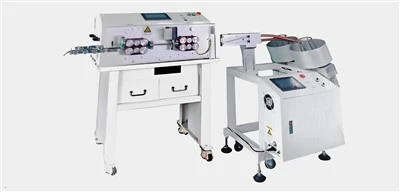
If you’re thinking about upgrading your production line to be fully integrated, or you’re not sure if your current handling is holding you back, reach out to our team. We’ll come to your facility, walk through your process, and show you exactly how our handling techniques can cut downtime, reduce errors, and boost your output. No sales pitch, no confusing jargon— just straight talk about what will work for your shop.
Threading Wire Seal Machine References:
- Material Handling Industry of America. (2022). "Integrated Automated Production Lines: Core Handling Techniques." MHIA Technical Report.
- Robotics Industries Association. (2021). "End-of-Arm Tooling Design for Automated Assembly." RIA Industry Guidelines.
- International Society of Automation. (2023). "Real-Time Data Integration for Traceability in Manufacturing." ISA Transactions.
- Collaborative Robotics Association. (2022). "Cobot Integration in Material Handling Systems for Small to Medium Manufacturers." CRA Research Paper.
Suzhou Keweisi Electronic Technology Co., Ltd.
We are one of the most professional integrated fully automated production line manufacturers and suppliers in China. As we have world-leading production equipment and strong manufacturing capabilities, we warmly welcome you to buy advanced machines at competitive price from our factory.
Address: Yunchuang road No.221, block C, Haibo tech park,Suzhou, P.R China.
E-mail: wenwei200982@126.com
WebSite: https://www.szkowas.com/
