If you’ve ever ordered rolls of SMT tape or spools of custom extruded film, you’ve probably stared at a stack of plain, dark plastic reels in our warehouse and wondered the same thing: why do they all look like that? As a reel supplier who’s been answering this question for 12 years—both on warehouse loading docks and late-night sales calls with electronics assembly teams—I’ll walk you through the shape of a plastic reel, why it’s not random, and what that shape means for every shipment that leaves our dock. Plastic Reel

First, let’s define what we’re actually talking about when we say “plastic reel.” This isn’t the wooden fishing reel your uncle keeps in the garage, or the giant metal spool used to pay out electrical cable on construction sites. The plastic reels we manufacture are engineered plastic components, most commonly made from polypropylene (PP) or high-impact polystyrene (HIPS), designed specifically to hold tight, even wraps of thin, flexible materials: SMT carrier tape for surface-mount electronics, flexible packaging film, medical device tubing, even the ribbon used in thermal transfer printing. They’re a workhorse, but their shape is far from arbitrary.
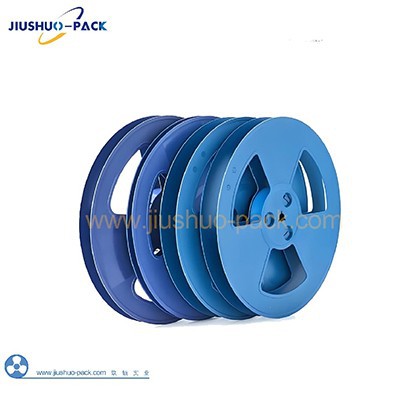
The core shape of almost every standard plastic reel we produce is a central cylindrical hub, two flat circular flanges extending outward from either end of that hub, and a shallow, narrow notch (called a “tear slot”) cut into the edge of one flange. On the surface, that looks like a thick washer with a pipe stuck through the middle—but every dimension of that shape is calibrated to solve specific problems that show up when you wrap thin, sensitive material around it.
Let’s start with the hub. The inner diameter (ID) of the hub is non-negotiable for most of our customers, because it has to fit their unwinding equipment. For SMT reels, which make up about 70% of our business, the standard hub ID is 13.78 mm (0.542 inches), the global standard for EIA-481 reels. That’s not a random number: it’s sized to slot into the motorized spindles of pick-and-place machines, which are the workhorses of electronics factories. If a reel’s hub is even a fraction of a millimeter too small, it won’t lock into the spindle, and the machine will jam mid-production, costing our customer thousands in downtime. If it’s too big, the reel will slip, leading to uneven feed and misaligned parts. We test every hub on our CNC lathes within ±0.02 mm of the standard, because that tiny tolerance is what keeps assembly lines running.
The hub’s outer diameter (OD) is equally important, though it’s often overlooked. Too small, and the thin material you’re wrapping will sag between the hub and the flange, creating loose, uneven wraps that can tangle. Too large, and the reel becomes unnecessarily bulky, wasting space in shipping containers and on factory floors. For standard 7-inch SMT reels, the hub OD is typically around 2 inches (50.8 mm) — a ratio that balances stability and portability.
Now the flanges, the most visible part of the reel’s shape. Flanges are the circular disks sticking out from either end of the hub, and their primary job is to contain the wrap of material so it doesn’t spill over the edges. But their shape isn’t just a flat disk. The edge of each flange is slightly rounded, not sharp, and the outer diameter (OD) of the flange varies depending on the reel’s intended use. For example, a 7-inch SMT reel has a flange OD of 177.8 mm (7 inches), while a smaller 4-inch reel for miniature connectors has a flange OD of 101.6 mm (4 inches). That size is standardized for compatibility: if you order 7-inch SMT tape, it will only fit a 7-inch reel, because the flange height is calibrated to hold exactly that length of tape without overhang.
Even the height of the flanges (the distance between the two flange disks) is specific to the material being wound. For thin SMT carrier tape (0.133 mm thick), the flange height is 1.5 mm, which is just enough to keep 100 meters of tape stacked neatly without shifting. For thicker medical tubing (1.5 mm thick), the flange height jumps to 5 mm, because thicker material requires more space and less risk of crushing under its own weight.
Wait, but what about custom shapes? We make a lot of non-standard reels for customers with unique needs: for a flexible packaging manufacturer, we’ve made reels with flanges that have a slight taper inward at the top, so film can be fed into a coating machine without catching; for a medical device client, we make reels with a smooth, matte hub to avoid scratching sterile tubing during transport. But even these custom shapes follow the same core rule: every curve, every dimension is a solution to a specific material-handling problem.
I’ve seen too many new suppliers cut corners on this shape, and the results are catastrophic. A client in Michigan once switched to a cheaper reel supplier because they thought all plastic reels were the same, only to find their SMT tape was tangling 3 times a day, leading to a full production shutdown for their automotive electronics line. When we tested their old reels, we found their flange edge was sharp, not rounded, so the tape would catch on the flange edge during unwinding. That’s the thing about this reel shape: it’s invisible until it’s wrong.
Beyond the functional shape for the material being wound, there are two other key dimensions that define a plastic reel’s shape: the “wind capacity” and the flange lip. The wind capacity is the space between the two flanges, which is calculated based on how much material a customer needs to hold. For example, a 7-inch reel can hold up to 500 meters of SMT tape, while a larger 15-inch industrial reel can hold thousands of meters of extruded film. The flange lip is the slight extra height added to the outer edge of the flanges, about 1 mm, to keep the wrapped material from sliding off the edge if a reel is tilted during shipping. That tiny lip is a small detail, but it prevents thousands of dollars in damaged goods every year.
You might be wondering why plastic reels don’t have a round, uniform shape like a roll of paper towels. The reason is all about stress and weight. A paper towel roll is wrapped around a cardboard tube, but it’s made of thin, flexible paper that doesn’t weigh much. A plastic reel, on the other hand, has to hold a heavy, tightly wound roll of material—sometimes 10 kg or more. The flat, rigid flanges provide structural support that a curved shape can’t. If a reel was made as a single curved piece, it would flex under the weight of the material, leading to uneven wraps and potential breakage. The two-flange, hub-and-spoke shape distributes the weight of the wound material evenly across the hub, so the reel is rigid enough to be stacked, shipped, and spun on a spindle without bending.
Another often-overlooked part of the reel’s shape is the center hole, or the core. While the hub’s outer diameter is important for holding the wrap, the inner hole has to fit the unwinding machinery perfectly. For SMT reels, this hole has a slight hexagonal or square indent (called a “keyway”) on the inner wall, so it locks into the spindle and doesn’t slip when the motor turns. That keyway is a critical shape detail: without it, the reel would spin unevenly, causing the material to be fed too fast or too slow. Some industrial reels even have two keyways, so they’re compatible with both left-handed and right-handed unwinding machines.
Over the years, we’ve also adapted the reel shape to meet sustainability demands, which is a big part of our business now. For customers looking to reduce plastic waste, we now make “empty reels” that are compatible with all standard sizes, so they can be reused multiple times instead of being thrown away after one use. The shape of these reusable reels is slightly thicker than standard disposable ones, to withstand multiple trips, but they still follow the same hub and flange dimensions to fit existing equipment. We also make “lightweight reels” for shipping, with thinner flanges and hollow hubs that cut the total plastic used by 25%, without compromising on structural strength.
At the end of the day, the shape of a plastic reel isn’t a design choice—it’s a precision engineering solution. Every curve, every millimeter of diameter, every notch and keyway is the result of decades of trial and error, tested against millions of wraps of sensitive materials. For our customers, that shape means less downtime, less damaged goods, and a more reliable supply chain. If you’re tired of reels that jam, tangle, or don’t fit your equipment, we can help you find the right shape for your needs. Whether you need standard SMT reels or custom reels for a unique application, we work with you to calibrate every dimension to your exact specifications, so your materials are handled perfectly every time. If you’d like to discuss your project and find the right reel shape for your products, feel free to reach out to our team to start the conversation.
Paper Carrier Tape References
- Electronic Industries Alliance. EIA-481: Standard for Surface-Mount Technology (SMT) Carrier Tapes and Reels. 2018.
- ASTM International. Standard Specification for Plastic Reels for Packaging Flexible Materials. ASTM D4965-19, 2019.
- Plastics Industry Association. Reel Design and Material Handling for Flexible Packaging. 2021.
- International Organization for Standardization. ISO 18957: Packaging—Plastic Reels for Electronic Components. 2016.
Dongguan Jiushuo Industrial Co., Ltd.
As one of the most professional plastic reel manufacturers and suppliers in China, we also support customized service. Please feel free to buy high quality plastic reel made in China here from our factory. Contact us for more details.
Address: 11th Floor, Building 2, Chuangfu Center, Chashan Town, Dongguan City, Guangdong Province, China
E-mail: sales06@zaidaiw.com
WebSite: https://www.carriertape-pack.com/
