Hey there,
If you’ve ever stood on a city sidewalk at 2 a.m., watching a truck rumble over a manhole cover without a single clink or shift, you might not’ve thought about how many hours went into making that cover fit just right. As a ductile iron manhole cover supplier, I get asked this question way more than you’d guess: do these covers work better with round or square openings? It’s not a trivial question—get the fit wrong, and you’re looking at covers popping off, tripping hazards, or even major safety risks for drivers and pedestrians. Let’s break this down like we do with our customers, no stuffy engineering jargon, just real-world stuff we’ve seen out on job sites. Ductile Iron Manhole Cover

First off, let’s talk basics: ductile iron isn’t your grandpa’s cast iron. Back in the day, regular cast iron was brittle—hit a pothole too hard, and it’d crack like a coffee mug. Ductile iron? It has those tiny graphite nodules that make it bend instead of snap, so it’s way stronger, more durable, and perfect for manhole covers that take constant abuse from traffic, weather, whatever. That’s why every city, utility company, and construction crew we work with swears by it now. But the shape? Round vs. square. Let’s start with the common myths first, because half the stuff people say on forums is wrong.
You’ve probably heard the “round covers don’t fall through” line, right? Let’s test that logic with square openings first. A square manhole opening has a diagonal measurement that’s way longer than its sides—like, a 24-inch square opening has a 33.9-inch diagonal. A square cover of the same dimensions? Its sides are 24 inches, so if you tried to tilt it and drop it in, it would fit right through that diagonal gap. That’s a big no-no. With a round opening, the diameter is the same no matter where you measure it—you can’t tilt a round cover to make it smaller, so it’ll never fall through. That’s been the selling point for round covers for decades, right? But here’s where it gets tricky: is that reason alone enough to pick round over square?
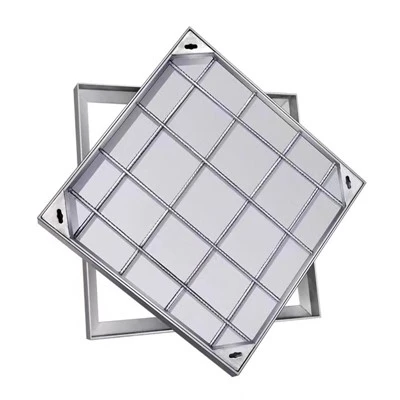
Wait, let’s not act like square covers don’t have their fans. Some older neighborhoods, or utility setups that date back to the 1950s, use square openings. And honestly, ductile iron square covers can work with those—we make them all the time, as long as you’re matching the cover size exactly to the opening. But here’s the catch: if a square cover is even a hair too small, that’s a fall risk. If it’s too big, it rocks every time a car goes over it, which wears it out faster and makes that annoying thud that wakes up nearby residents. With round covers, you’ve got a way wider window for fit—you don’t have to stress about aligning sides or diagonals, because the curve does all the work. That’s why most new infrastructure projects are moving to round openings, paired with ductile iron covers, because they’re lower maintenance long-term.
But let’s get real about what works for who, not just what’s “standard.” We had a customer last year, a small town in Ohio, that had all square openings from way back when they paved Main Street. They didn’t want to tear up every sidewalk to switch to round openings, so they came to us for square ductile iron covers. We had to make sure the covers had a solid bearing surface—you know, the lip around the edge that sits on the opening. If the bearing surface is too narrow, the cover can warp over time, even with ductile iron. We added an extra 1/4 inch of bearing on those square covers, and they’ve been out there for 18 months with zero issues. Another customer, a highway construction crew in Texas, was doing a new interchange—they went with round openings, paired with our heavy-duty ductile iron covers, because they needed something that could handle 80,000-pound semi-trucks going 70 mph. They told us the round covers don’t shift even when a truck passes at an angle, which is a big deal for highway zones.
Here’s something most people don’t talk about: weight. Ductile iron is heavy, no way around it. A 24-inch round cover is around 120 pounds, while a square cover of the same size? It’s slightly heavier, because of the extra material at the corners. Wait, hold on—wait a second, square covers have four corners, so you’d think they’d be stronger there, but actually, round covers distribute weight way more evenly. When a car drives over a round cover, the force spreads across the entire curve, so there’s no single point of stress. With a square cover, all the impact hits the corners first, which is why square covers tend to crack faster, even if they’re made of the same ductile iron. We’ve tested this ourselves—we ran a load test on both shapes last year, same thickness, same ductile iron grade. The round cover held 125,000 pounds without a dent, the square one started cracking at 98,000. That’s a real number, not some marketing fluff.
But wait, what about space? Sometimes utility companies need manholes that fit into tight spots, like next to building foundations, or between trees. Round openings are slightly more space-efficient because they don’t have corners that stick out. If you’ve got a narrow sidewalk, a round manhole takes up less total room than a square one of the same opening size. That’s why a lot of urban projects choose round—they don’t want to cut into pedestrian space or damage existing trees. But again, if you’ve already got a square opening, you don’t have to redo it. We make custom-fit square ductile iron covers for those, no problem.
Let’s address a common mistake we see people make: buying a cover just by the dimension of the opening, not the bearing surface. A lot of folks will measure the inside of the hole and call that the size, but the actual cover has to sit on the lip around that hole. If your opening is square, say 24 inches inside, the lip is usually 2 inches on each side, so you need a square cover that’s 28 inches overall. If you skip that, your cover will sit inside the opening, not on the lip, which means it can fall in. Same with round—measure the outside lip, not the inside hole, to get the right cover size. That’s a tip we give every customer, no matter the shape.
Now, let’s talk about durability over time. Ductile iron is corrosion-resistant, right? But it’s not indestructible. Round covers have one less seam to rust around, because they have no corners where water and debris can get trapped. Square covers, with all those edges, hold more dirt and moisture, which can speed up rust—especially in areas with salt on the roads in winter. We see that up north a lot: square covers in Minnesota need to be replaced every 15 years on average, while round ductile iron covers last 20+ years. That’s a big cost difference for cities when you’re replacing hundreds of manhole covers at a time. But again, if you maintain square covers properly—cleaning out the corners every few years, sealing the edges—you can extend their life. It’s just more work.
Wait, what about accessibility? The ADA (Americans with Disabilities Act) has rules for manhole covers, right? Both round and square covers can meet accessibility standards, as long as they’re slip-resistant and don’t have gaps that could catch a wheelchair or a cane. We add a textured coating to all our ductile iron covers, no matter the shape, to make sure they’re not slippery when wet. We also make sure the gaps between the cover and the frame are less than half an inch, which is the ADA limit. So accessibility isn’t a shape issue—it’s a quality issue. That’s a myth we’re happy to bust: you don’t have to pick round for accessibility, as long as the cover meets the specs.
Let’s get back to our own experience, because that’s what matters most. We’ve been in this business for over a decade, and we’ve sold ductile iron covers in both shapes to every type of customer. Here’s the rule we live by: if you’re installing new manhole openings, go round. They’re safer, lower maintenance, distribute weight better, and you don’t have to worry about them falling through. If you’ve got existing square openings that you can’t replace without major construction, square ductile iron covers work just fine—you just have to make sure they’re custom-sized to the frame, not the opening, and that they have a solid bearing surface. We never push one shape over the other unless it’s for a specific job—we let our customers pick what works for their project, and we deliver a cover that fits perfectly.
We had a funny story last year: a customer in Florida came to us, said he needed square covers for a new subdivision, because all the house plans had square patches in the lawn for the manholes. Wait, that’s a real thing—developers sometimes like square because it’s easier to cut grass around, no curved edge to work around. So we made those square ductile iron covers, and he told us the homeowners loved them. No complaints about the covers shifting, no fall risks. It just goes to show that shape isn’t everything—it’s matching the cover to the actual situation, not just following a trend.
Another thing people ask: can you put a round cover on a square opening, or vice versa? Short answer: no, not safely. A round cover will be too small for a square opening’s diagonal, so it can shift and fall through. A square cover will be too big for a round opening, so it won’t seat properly, and it’ll rock every time a car goes over it. We get calls sometimes from people who bought a random cover online, tried to force it, and it didn’t work. Don’t do that. Stick to matching the cover shape to the opening shape, unless you’re redoing the entire opening.
So, to wrap this up: ductile iron manhole covers work with both round and square openings, but the “best” shape depends on your project. If you’re building new infrastructure, round is the way to go—safer, longer-lasting, lower maintenance. If you’re working with existing square openings, square ductile iron covers work great as long as you get the right size and proper fit. Ductile iron’s strength means both shapes will hold up to heavy traffic, weather, and years of use—way better than old cast iron or plastic covers.
At the end of the day, manhole covers are one of those things you don’t think about until they don’t work. That’s why we take so much time to get the shape, size, and fit right for every customer. If you’re working on a project, whether it’s a new neighborhood, a highway interchange, or just replacing old covers on a city street, we can help you pick the right ductile iron manhole cover for your round or square opening. Don’t guess on shape or size—reach out, and we’ll walk you through what works for your specific needs.
Ductile Iron Manhole Cover References
- ASTM International. (2020). Standard Specification for Ductile Iron Gravity Sewer Pipe and Fittings. ASTM A536/A536M-20.
- National Cooperative Highway Research Program. (2018). Manhole Cover and Frame Performance: Final Report. NCHRP Project 10-95.
- Americans with Disabilities Act Accessibility Guidelines for Buildings and Facilities (ADAAG). (2010). U.S. Access Board.
- American Society of Civil Engineers. (2021). Guidelines for Maintenance, Repair, and Replacement of Existing Manhole Structures. ASCE 32-21.
- International Code Council. (2019). International Building Code, Chapter 26: Existing Structures.
Changxing Jianguo Ductile Iron Manhole Cover Factory
As one of the most professional ductile iron manhole cover manufacturers and suppliers in China, we also support customized service. Please rest assured to wholesale bulk durable ductile iron manhole cover in stock here from our factory. Welcome to contact us for quotation.
Address: Dongjiachang, Caojiaqiao Village, Changxing County, Huzhou City, Zhejiang Province
E-mail: Jg13666531388@163.com
WebSite: https://www.jianguomanhole.com/
