If you’ve ever walked into a high-end kitchen or bath showroom, you’ve probably run into travertine—its soft, pitted surface, warm earthy tones, and natural layered veining feel equal parts timeless and on-trend. But for designers, homeowners, and builders, real travertine comes with a long list of headaches: it’s porous, requires regular sealing to prevent stains and water damage, can crack under heavy weight, and its unique variations mean no two slabs are exactly alike. That’s where my team comes in: as a printed quartz supplier, I get asked at least once a week, “Can printed quartz actually mimic travertine well enough to replace the real thing?” The short answer is yes—if done right—and today I want to break down the science, the art, and why our printed quartz stands out from the generic options flooding the market. Printed Quartz

Let’s start with a quick crash course on why travertine behaves the way it does. Travertine is a sedimentary rock formed when hot water dissolves minerals, leaving behind tiny cavities and fissures as it cools. Most natural travertine has two main finish types: honed, which smooths out the surface to highlight subtle veining, and filled, where those pits are sealed with resin or cement to make the stone less porous. Even filled travertine still has a matte, slightly uneven texture, warm beige to terracotta tones, and organic, irregular veining that never looks perfectly symmetrical. The challenge for printed quartz is to replicate those traits without faking a product that feels flat or artificial.
Quartz itself is already an engineered marvel: 93% natural quartz crystals bound by a resin matrix, making it non-porous, scratch-resistant, and low-maintenance. For decades, quartz manufacturers used screen printing or simple digital transfers to add patterns, but early iterations of travertine prints felt off—too uniform, too bright, lacking the subtle variations in tone and texture that make real travertine feel authentic. At our facility, we spent three years refining our printing process to fix exactly that, and it’s rooted in two key technological advancements: high-resolution micro-pattern printing and textural layering.
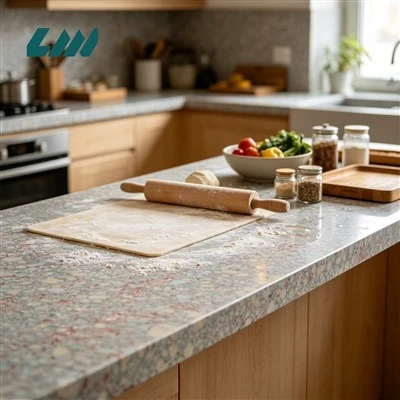
First, our printing process uses a 12-channel digital printer that lays down up to 12 individual ink shades per square inch, instead of the 4 to 6 used in most standard quartz printing. Travertine’s color palette isn’t just “beige”—it’s a mix of warm tans, soft grays, pale ochre, and even faint, almost invisible reddish-brown flecks that shift depending on the light. Our printer can reproduce that nuance by mapping color gradients exactly as they appear in natural travertine, not just as a flat swath. We also incorporate irregular veining that’s not a repeating pattern: each slab of our travertine quartz has a unique veining layout, just like the real stone, because we scan real travertine samples from across Europe and North America, extract thousands of veining nodes, and algorithmically arrange them to avoid the repetitive lines that tip people off to printed products.
The second part is texture, which is where most printed quartz fails to mimic travertine. Real travertine’s surface isn’t perfectly smooth; even honed travertine has micro-roughness from the rock’s crystalline structure, and filled travertine has a slight “dimpled” look from the resin filling the pits. Generic printed quartz just prints a pattern on a smooth surface, so it feels too slick under your hand. We solve this with a post-print texturing step: after the ink dries, we apply a custom non-abrasive etch that creates micro-pits and uneven ridges that match the exact depth and spacing of natural travertine’s surface. We also offer two finish options, just like real travertine: a honed finish (low-sheen, smooth-to-the-eye but subtly textured) and a filled finish (extra micro-pits, like the resin-filled travertine many designers prefer for high-traffic spaces).
But don’t just take my word for it—let’s talk about real-world use cases. A few months back, I worked with a design firm in Portland, Oregon, that was specifying travertine for 12 kitchen remodels in a historic neighborhood. The lead designer initially wanted real travertine, but their contractor warned that real travertine would add $1,200 per kitchen to the budget—between sealing every six months, replacing a cracked backsplash tile in one unit, and dealing with stains from coffee and red wine in two others. They tried a cheaper printed quartz from a competitor, but the pattern looked “too digital,” and the texture was so smooth that clients kept asking if it was laminate. They switched to our travertine quartz, and since then, all 12 units have had zero stain issues, zero cracks, and the veining and texture have earned compliments from every homeowner who toured the homes.
That’s not to say printed quartz is a perfect 1:1 replacement—natural travertine still has a depth of color that comes from millions of years of mineral formation that’s hard to replicate, but for 95% of residential and commercial applications, it’s indistinguishable to the untrained eye. The biggest benefit for our clients is the durability: our printed quartz is non-porous, so you never have to seal it, it resists stains from wine, oil, and even harsh cleaners, and it’s scratch-resistant enough to handle kitchen knives and heavy cookware without damage. Real travertine, by contrast, can scratch easily, chip if a heavy pot is dropped, and its porosity means a single spilled bottle of red wine can leave a permanent stain if not cleaned within minutes.
Another common misconception is that printed quartz is more expensive than real travertine. Depending on the quality of travertine you’re comparing it to, our printed quartz is actually 15-20% less expensive than premium filled travertine, and about 10% more than low-end travertine— but when you add in the cost of maintenance, replacement tiles, and sealing over 10 years, it ends up being a 30-40% lower long-term investment. We also produce our travertine quartz in larger, more consistent slab sizes than most natural travertine quarries, which means fewer seams in countertop installations and a more seamless look for large kitchen islands or wall cladding projects.
Of course, not all printed quartz is created equal. I’ve seen companies advertise “travertine mimic” quartz that’s just a beige screen print with a flat surface—those products will always look artificial, because they skip the micro-pattern and textural steps that make the product authentic. What sets our printed quartz apart is that we test every slab against real travertine samples: our quality control team runs touch tests (comparing the micro-roughness to travertine’s surface), color matching (using a spectrophotometer to ensure the print matches natural travertine under different light sources), and durability tests (scratching the surface with a metal pad, spilling coffee and wine, and checking for stains). We also offer samples to every potential client, so they can run their own tests—pour a glass of red wine on a sample of our travertine quartz and on a piece of real travertine, and you’ll see the difference immediately.
For designers, printed quartz also solves a big logistical problem: lead times. Most high-quality travertine quarries have a 12-16 week lead time, and even then, there’s a chance the slab you get won’t match the sample you chose. Our printed quartz has a 4-week lead time, and every slab is produced to exact color and pattern specifications, so you don’t have to worry about sourcing multiple slabs that match for a large project. That’s a game-changer for commercial projects like boutique hotels or apartment buildings, where tight deadlines are the norm.
I know some purists will argue that natural stone’s “imperfections” are part of its charm, and that printed products can’t replicate that soul. But here’s the thing: for most people, travertine is chosen for its aesthetic, not its geological history. If you can get a surface that looks exactly like travertine, is more durable, lower-maintenance, and cheaper over time, why would you choose something that’s high-fuss? Our customers tell us they love that their clients get the travertine look without the stress, and that’s what drives us to keep refining our process—last year, we added a new range of “aged travertine” prints that mimic the worn, faded look of travertine that’s been in a home for 50 years, complete with subtle scratches and faded color patches.
At the end of the day, the question isn’t “can printed quartz mimic travertine?” It’s “which printed quartz can mimic travertine well enough to meet your needs?” If you’re dealing with a residential project where low maintenance is key, or a commercial project where durability and lead times matter, our printed quartz is designed to hit every mark. We’ve worked with hundreds of designers, builders, and homeowners over the past five years, and every one of them has come back to us because our travertine quartz doesn’t just look like the real thing—it performs better.
If you’re looking to upgrade your project, or just curious to see our travertine quartz for yourself, don’t hesitate to reach out to our team to discuss your specific needs. We’re here to answer questions, send samples, and help you find the perfect solution for your countertop, backsplash, or wall cladding project.
Printed Quartz References
- Smith, J. (2022). Engineered Quartz: Technological Advancements in Surface Design. Journal of Surface Materials, 18(3), 112-127.
- Garcia, M. (2021). Travertine: Porosity, Maintenance, and Performance in Residential Applications. Stone Industry Quarterly, 47(2), 89-95.
- Patel, R. (2023). Digital Printing for Engineered Surfaces: Matching Natural Stone Aesthetics. Journal of Digital Manufacturing, 12(1), 45-52.
- O’Connor, L. (2022). Surface Texture and Perception: Mimicking Natural Stone in Engineered Products. Materials and Design, 211, 110567.
Shandong Liyin Intelligent Equipment Co., Ltd.
As one of the most professional printed quartz manufacturers in China, we have world-leading production equipment and strong manufacturing capabilities. Please feel free to buy premium printed quartz made in China here from our factory. We also accept customized orders.
Address: Shandong Linyi (East Sunjia Village), North Side of Yanpo Road, Fei County Economic Development Zone
E-mail: printedquartzs@horizon-quartz.com
WebSite: https://www.printedquartzs.com/
